
The Magic of Compound Interest: Building Wealth Effortlessly
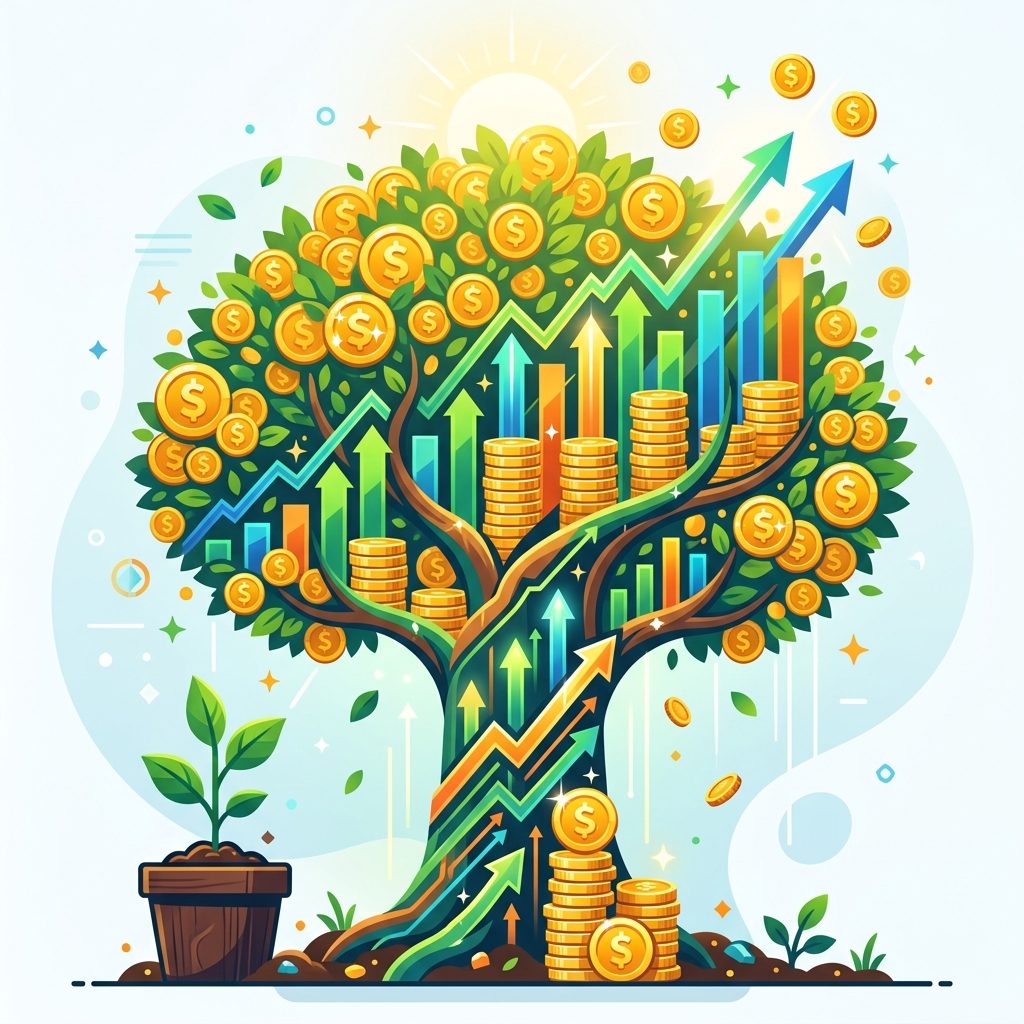
We’ve all heard the quote misattributed to Albert Einstein calling compound interest the “eighth wonder of the world.” The quote usually ends with: “He who understands it, earns it; he who doesn’t, pays it.”
Regardless of who actually said it first, the underlying truth is undeniable. When it comes to building long-term wealth without having to invent the next big app or win the lottery, few things move the number as reliably as compound interest. But what exactly is it, and why does it feel so magical when you finally see it working in your own bank account?
What is Compound Interest?
At its simplest, compound interest is just “interest on your interest.”
Let’s break that down. When you invest money (your principal), it earns a return. If you take that return out and spend it, you’re earning simple interest. But if you leave that return in your account, your new, larger balance will earn even more interest the following year.
It starts slow. Almost painfully slow. For the first few years, it feels like you’re just pushing a boulder up a hill. But as that boulder gathers momentum, it creates a snowball effect. Over long periods, the growth curve turns from a boring straight line into a sharp, upward hockey stick. Suddenly, your money is making more money than your day job.
The Formula Behind the Magic
The compound interest formula is deceptively simple:
A = P × (1 + r/n)^(n×t)
Where:
- A = Final amount
- P = Principal (your initial investment)
- r = Annual interest rate (as a decimal)
- n = Number of times interest compounds per year
- t = Number of years
The key variable hiding in plain sight is t: time. Because time sits in the exponent, it doesn’t just add to your returns, it multiplies them. This is why starting early, even with small amounts, is so dramatically more powerful than starting late with large amounts.
The True Cost of Waiting (A Tale of Two Investors)
When people ask me for the “secret” to investing, they usually expect a hot stock tip or a complex options strategy. My answer is always the same, and it’s terribly boring: Time.
Time does all the heavy lifting in the compound interest equation. Let me show you what I mean with a classic hypothetical scenario:
Meet Sarah (The Early Bird): Sarah starts investing $500 a month right on her 25th birthday. She is disciplined for exactly 10 years. Then, at age 35, life gets expensive, and she stops contributing entirely. But here is the crucial part: she leaves the money invested to grow until she is 65.
Meet David (The Late Bloomer): David puts off investing in his twenties. At age 35, he realizes he needs to catch up, so he starts investing $500 a month. He continues contributing every single month, without fail, for 30 straight years until he reaches 65.
Assuming both get a historical average of a 7% annual return, who ends up with a bigger nest egg at 65?
Incredibly, Sarah wins. Even though she only contributed out-of-pocket for 10 years ($60,000 total), her 10-year head start allowed compounding to push her final balance higher than David’s, even though he contributed for 30 grueling years ($180,000 total).
David invested three times as much of his own hard-earned cash, but he could never catch up to the sheer mathematical force of Sarah’s 10-year head start.
How Compounding Frequency Changes the Outcome
Interest doesn’t always compound once a year. Depending on the account or investment, compounding can happen annually, quarterly, monthly, or even daily. The more frequently interest compounds, the faster your money grows, though the difference diminishes as frequency increases.
Here’s what $10,000 looks like after 20 years at 7% interest with different compounding frequencies:
| Compounding Frequency | Final Balance | Interest Earned |
|---|---|---|
| Annually (1x/year) | $38,697 | $28,697 |
| Quarterly (4x/year) | $40,064 | $30,064 |
| Monthly (12x/year) | $40,387 | $30,387 |
| Daily (365x/year) | $40,547 | $30,547 |
The jump from annual to monthly compounding adds about $1,690 for doing nothing differently. Note also that the gains shrink as you go: annual to quarterly is worth $1,367, quarterly to monthly only $323, and monthly to daily a mere $160. Past monthly compounding, the frequency stops mattering much.
The Rule of 72: A Mental Math Shortcut
Want to quickly estimate how long it will take to double your money? Divide 72 by your annual interest rate.
- At 6% returns: 72 ÷ 6 = 12 years to double
- At 8% returns: 72 ÷ 8 = 9 years to double
- At 10% returns: 72 ÷ 10 = 7.2 years to double
- At 12% returns: 72 ÷ 12 = 6 years to double
This means that at a 7% average market return, your money doubles roughly every 10 years. $10,000 becomes $20,000 after 10 years, $40,000 after 20, $80,000 after 30, and $160,000 after 40 years, all without adding a single extra dollar.
The Dark Side: Compound Interest Working Against You
Compound interest is a double-edged sword. The same force that builds wealth in a savings or investment account can devastate your finances when it works in reverse through debt.
Credit card interest rates typically range from 18% to 29% APR, compounding daily. A $5,000 credit card balance at 22% APR, paying the common minimum of 1% of the balance plus that month’s interest, takes about 19 years to clear and costs roughly $8,100 in interest, more than the original balance. The minimum formula matters enormously here: on a flat 2%-of-balance minimum the same debt would take over 70 years, because the payment shrinks as fast as the balance does.
This is precisely why financial advisors consistently recommend paying off high-interest debt before investing. Earning 7% on investments while paying 22% on credit card debt is like trying to fill a bathtub with the drain wide open.
How to Harness the Power of Compounding Today
You don’t need a finance degree to make this work for you. Here is the playbook:
- Start Today (Seriously): Stop waiting until you have a “large enough” amount to invest. Mathematically, a small amount invested today is vastly more valuable than a large amount invested a decade from now. Open the account. Transfer fifty bucks. Just start the clock.
- Automate Everything: Willpower is a finite resource. Set up automatic transfers from your checking account to your investment accounts the day after your paycheck hits. Out of sight, out of mind.
- Turn on DRIP: Ensure your brokerage account is set to a Dividend Reinvestment Plan (DRIP). This automatically buys more shares with the dividends you receive, fueling the compounding fire without you having to lift a finger.
- Eliminate High-Interest Debt First: Kill credit card balances and personal loans before investing aggressively. Compound interest working against you at 20%+ will outpace any investment gains.
- Maximize Tax-Advantaged Accounts: Contribute to 401(k), IRA, KiwiSaver, or your country’s equivalent retirement accounts first. The tax savings accelerate compounding because more of your money stays invested rather than going to the tax authority.
- Be Patient and Boring: Compounding is incredibly boring in the first decade. The real, life-changing magic happens in decades two, three, and four. When the market dips, don’t panic sell. Stay the course.
See It for Yourself
If you want to see exactly how your own numbers look, play around with our free Compound Interest Calculator. Punch in your current age, what you can afford to save monthly, and visualize your own path to financial independence. Try changing just the start year by five years in either direction. The difference will surprise you.
You can also use our Savings Goal Calculator to figure out how much you need to set aside each month to hit a specific target, and our ROI Calculator to compare the returns on different investment options side by side. The math doesn’t lie!